
Anesthesiologist salary report 2026: How much do anesthesiologists make?
August 17, 2026
If you're an anesthesiologist, there's a good chance you've wondered how your pay compares to the rest of the field, or what it would take to earn more. The average anesthesiologist earned $543,000 in 2025, according to Medscape's 2026 Physician Compensation Report, making it one of the highest-paid specialties in medicine. The more interesting question is what that pay could be doing for you right now, and whether locum tenens could put your earnings to work faster. Here's what the data says, along with what real anesthesiologists who've added locums to their careers have to say about their compensation.
Anesthesiologist salary: National average and range
At $543,000, the average anesthesiologist salary is well above the $386,000 average across all physicians and the $417,000 average for specialists. Anesthesiology was one of only eight specialties to break $500,000 in average pay last year.

That's not a one-year fluke, either. Anesthesiology was one of just three specialties, alongside cardiology and radiology, that ranked in the top five for both total pay and pay growth. Compensation for anesthesiologists grew by roughly 8% year over year, a pace few other fields matched.

As an anesthesiologist, it's a strong position to be in. Keep reading to find out what you can do to increase your earning power even further.
Why anesthesiologist compensation keeps climbing
A few things are driving anesthesiology's place near the top of the pay scale. Demand for anesthesia coverage has remained strong relative to the supply of anesthesiologists, and the work itself is tied directly to surgical and procedural volume, meaning it's rarely optional or deferrable, unlike some other care.
Combine that with a specialty that's consistently ranked in the top five for both pay level and pay growth, and you get a field where compensation has kept climbing even as other parts of medicine have leveled off.
What's the hourly wage for an anesthesiologist?
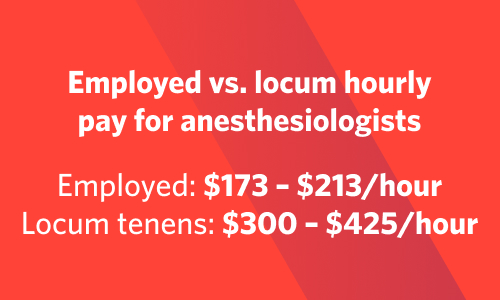
For an employed anesthesiologist, hourly pay generally falls between $173 and $213 an hour, according to the Bureau of Labor Statistics and Salary.com. Actual pay varies by person, but this range gives a good general sense of what staff anesthesiologists earn per hour.
Many anesthesiologists supplement their income with outside work
A strong salary doesn't always feel like the whole picture, and anesthesiologists aren't the only ones looking for ways to add to it. According to Medscape's 2026 report, 40% of physicians say they take on some form of paid work outside their regular hours, and that figure holds essentially the same for specialists overall, including anesthesiologists.

That extra work takes different forms, from picking up more hours at a primary job to non-medical side work. But for a growing number of anesthesiologists, it means locum tenens.
Learn more: What is locum tenens?
What locum tenens anesthesiologists actually earn
Locum tenens work—temporary assignments that fill staffing gaps and maintain patient care—can be a great way to increase your income as an anesthesiologist.
Locum tenens pay for anesthesiologists currently ranges from $300 to $425 per hour, according to Locumstory's compensation data. This can be a significant increase over the $173 to $213 average pay range for employed anesthesiologists. Where you land in that range depends on a few things: location, practice setting, your experience, and whether the assignment includes call. Pay can vary quite a bit from one assignment to the next, so think of that range as a starting point for a conversation with a consultant, not a guarantee.
There's also a piece of the picture your paycheck doesn't always show. Dr. Kenneth Song, an anesthesiologist who made the switch from private practice, put it this way: "You'll find that your compensation from locums greatly outweighs any of the benefits that you're getting from your practice, and you'll have a better pay opportunity working locums."
It's worth keeping that distinction in mind. A strong number on paper doesn't always translate into a strong number in your bank account once overhead, fees, and practice costs are factored in. For many anesthesiologists, locums changes that equation in ways a simple salary comparison doesn't capture.
Set that next to the hourly figures above, and the gap starts to explain why so many anesthesiologists are taking a second look at locums—not as a replacement for their career, but as a way to add to it.
Find out: What it’s like working as a locum tenens anesthesiologist
Anesthesiologist locum tenens pay by career stage
Where locums fits best often depends on where you are in your career.

Early career: Pay off medical school debt faster
If you're coming out of an anesthesiology fellowship, you already know the pay cut that comes with it. Stipends at academic fellowship programs typically range from $90,000 to $110,000 per year. Hospital for Special Surgery's regional anesthesiology and acute pain medicine fellowship, for example, lists a stipend of $109,900, while programs at Cedars-Sinai in similar subspecialties list figures closer to $90,000 to $105,000, with a housing stipend included at some. Meanwhile, the average debt carried by physicians tops $246,000. That's a real debt to sit with for a year or more while training wraps up, especially with an average anesthesiologist pay of $543,000 waiting on the other side. If debt payoff is the priority right now, our guide to paying off medical school debt walks through strategies other physicians have used to accelerate the timeline.
For physicians finishing up training, locum tenens assignments, whether picked up during a lighter fellowship schedule or right after boards, can be one of the more direct ways to increase your earnings instead of waiting it out. For a broader look at what your first few years in locums could look like, our Physician Career Launch Guide covers everything from interviews to financial planning.
Mid-career: Increase your work-life balance
For anesthesiologists further into their careers, the appeal of locums often has less to do with needing more money and more to do with wanting more say over how and when you work.
I think it definitely is empowering to take control of your schedule while still ensuring consistent income.
The desire to have both work-life balance and a reliable income is a common thread among mid-career anesthesiologists who add locums to their practices. These clinicians don't need to choose between stability and flexibility, as they have complete control over how much they work, their schedule, and the type of clinical setting they prefer.
Learn more: The pros and cons of locum tenens
Late career: Ease into retirement
Anesthesiologists considering a transition to retirement use locums to continue practicing medicine without the demanding workload. You can choose to work fewer hours while maintaining your medical license or explore new places by choosing assignments in locations you'd like to visit.
If you're further along in your career and locums feels like a step down from where you've been, it's worth hearing that from someone who had the same hesitation and worked through it with a consultant. Our guide to transitioning into retirement with locums walks through exactly this situation in more detail.
What locums income means for your taxes
Most locum tenens work comes with 1099 independent contractor status rather than a W-2, which opens financial opportunities not available to employed physicians, such as a solo 401(k) or deductions tied to your work as a contractor. It's a real part of the financial picture, and one worth understanding before your first assignment. Our locum tenens tax guide breaks down deductions and entity options in more detail.
This is general information, not tax or financial advice. Every physician's situation is different, so talk with a qualified tax professional or financial planner about what these options could mean for you.
Have questions about locums income? Read The finances of locum tenens
Do the math for yourself
Curious what locum tenens could actually mean for your bottom line? Click below to find free calculators that estimate your potential locums earnings and show how much faster you could pay off your debt. It only takes a few minutes to see the numbers for yourself.
Ready to see what's possible?
Whether you're paying off medical school debt, building toward retirement, or just looking for more control over your schedule without giving up income, locum tenens is worth running the numbers on.
Give us a call at 954.343.3050 to speak with a Weatherby consultant, or view today's anesthesiology locum tenens opportunities.
Recommended Articles
Categories

Thank you,
We appreciate you contacting us. A consultant will be reaching out to you shortly to discuss this job opportunity. You can also get in touch with us directly by calling 954.618.5296.